About patents
Shin-Etsu Chemical has a large number of patents on materials and manufacturing methods in the world around the grain boundary diffusion alloy method (*1).
Among numerous owned patents, I will inform you of the features below, especially regarding representative patents (*2).
Patent content features
- The existence of F (fluorine) is observed in the rare earth sintered magnet body.
- F (fluorine) is distributed from the center of the magnet body toward the surface of the magnet body so that the content concentration is increased.
- *1.Grain boundary diffusion alloy method
- A technology to dramatically increase coercive force (Hcj) by placing a small amount of heavy rare earth (Tb, Dy, etc.) at an appropriate position.
Shin-Etsu Chemical's technology is called grain boundary diffusion alloy method. - *2.Patent registration number (part)
-
Japan: 4702546 / 4702547 / 4702548 / 4702549
China: ZL200610009370.7 / ZL200610019898.2 / ZL200610019899.7 / ZL200610009371.1
USA: 7488393 / 7488395 / 7520941 / 7488394
EP: 1705671 / 1705670 / 1705668 / 1705669
- For further information on the above patents, please contact below.
-
Shin-Etsu Chemical Co., Ltd. Magnetic Materials Div.
TEL: 81-3-3246-5215
- Patent content features
- The above information is stated for your reference.
Shin-Etsu Chemical Co., Ltd. can not assume any responsibility even if everyone should suffer damage due to the above information, so please judge and act with everyone's own responsibility I will tell you.
Shin-Etsu Chemical Co., Ltd. can not assume any responsibility should anyone suffer any damage due to the above information, so please be responsibe for utlizing your own judgement and actions.
About the technology
2007.03.28
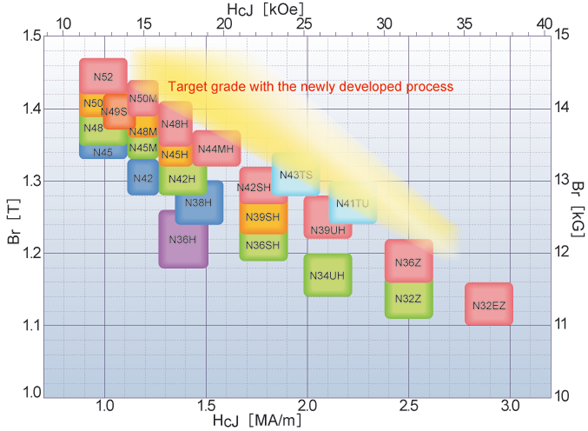
"The Alloying Process by Grain Boundary Diffusion" is a new technology developed by Shin-Etsu Chemical, in which the havey rare-earth is concentrated near the grain boundaries of the Nd-Fe-B sintered magnet. With this new process, further enhancement in coercivity and suppression of reduction in remanence, compared with the conventional "Two Alloy method", has been realized.
In this section, we will explain this new technology.
In this section, we will explain this new technology.
First of all, let's see the coercivity mechanism of the Nd-Fe-B magnet through the relationship between a magnetization curve and magnetic domain wall movements.
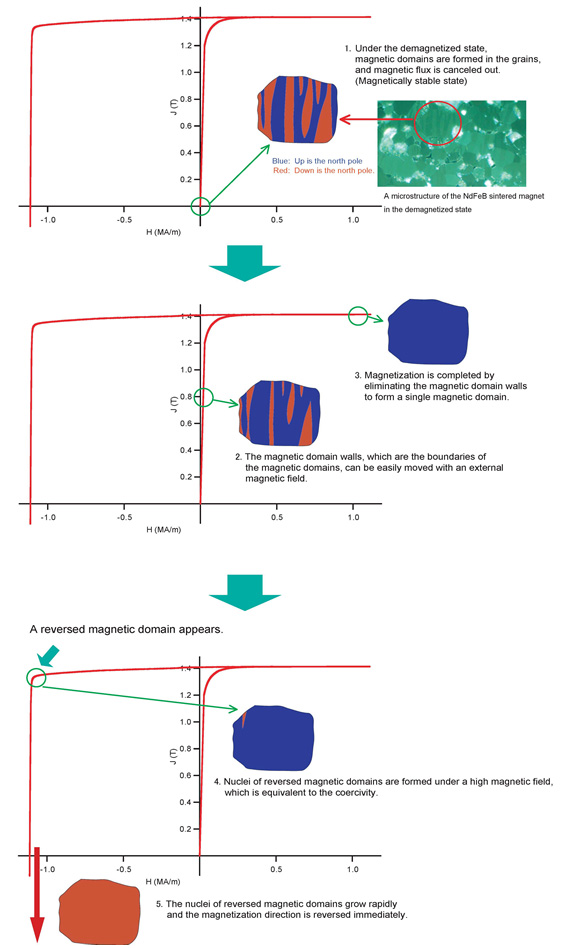
Thus, the coercivity of Nd-Fe-B sintered magnet is governed by a magnetic field which causes nucleation of reversed magnetic domain. Enhancement of the anisotropy field is effective for suppressing the nucleation, so that the higher coercivity can be achieved.
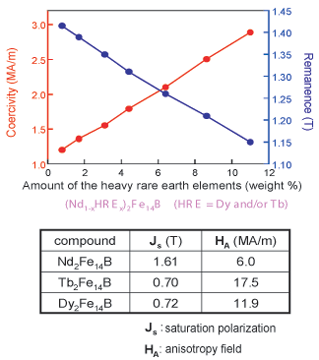
Coercivity can be enhanced by partial substitution of Nd by heavy rare earths such as dysprosium and terbium which increase the anisotropy field. However, as shown in the right-hand figure, the coercivity increases with increasing the amount of substitution, while the remanence decreases.
Coercivity can be enhanced by partial substitution of Nd by heavy rare earths such as dysprosium and terbium which increase the anisotropy field. However, as shown in the right-hand figure, the coercivity increases with increasing the amount of substitution, while the remanence decreases.
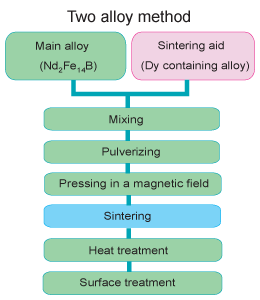
Consequently, Shin-Etsu Chemical developed an alternative process called "Two Alloy Method". In this process, two alloys with different melting points are mixed and then sintered; one is the main alloy whose composition is close to the stoichiometry of the magnetic compound and free from heavy rare earth elements, another is a sintering aid (i.e. an alloy with a low melting point) containing heavy rare earths. By this process, heavy rare earths such as dysprosium which increase the anisotropy field, are concentrated selectively near the grain boundaries. As a result enhancement of coercivity with suppression of serious reduction in remanence can be achieved and efficient usage of heavy rare earths can be realized.
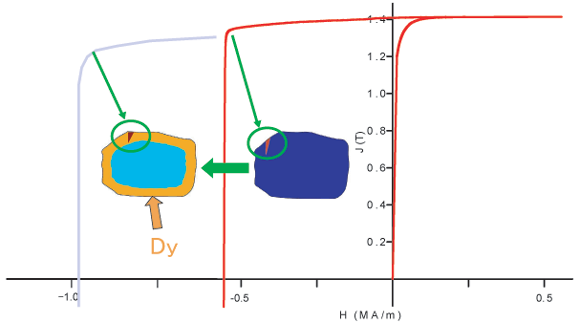
Furthermore, "New Alloying Process by Grain Boundary Diffusion", newly developed by Shin-Etsu Chemical, has realized a significant enhancement in coercivity with suppression of reduction in remanence due to a sharp distribution of heavy rare earths such as dysprosium and higher concentration of dysprosium compared with the conventional Two Alloy Method.
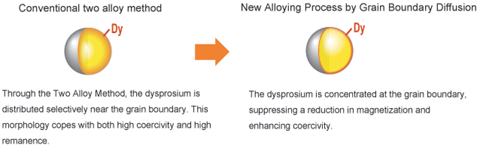
With the conventional Two Alloy Method, since the dysprosium is diffused during sintering at high temperatures, the dysprosium is distributed widely in the interior of grains, and so an excess of dysprosium is necessary. In the New Alloying Process by Grain Boundary Diffusion, sintered bodies are coated with the rare earth compound and then heat treated at lower temperatures than sintering temperatures (diffusion treatment). Using this new process, the amount of dysprosium diffused into magnets can be appropriate and more efficient usage of heavy rare earths can be realized.
With the conventional Two Alloy Method, since the dysprosium is diffused during sintering at high temperatures, the dysprosium is distributed widely in the interior of grains, and so an excess of dysprosium is necessary. In the New Alloying Process by Grain Boundary Diffusion, sintered bodies are coated with the rare earth compound and then heat treated at lower temperatures than sintering temperatures (diffusion treatment). Using this new process, the amount of dysprosium diffused into magnets can be appropriate and more efficient usage of heavy rare earths can be realized.
Image diagram
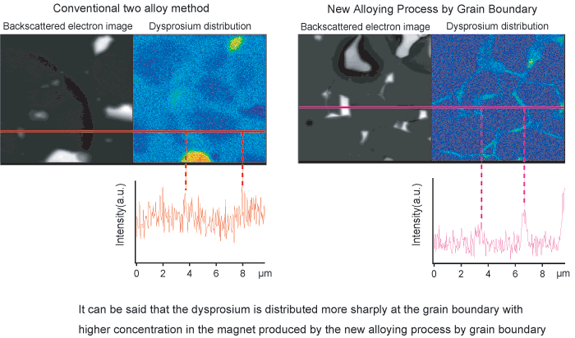
Comparison using actual metallographic structure photographs
As shown in the lower figure, the New Alloying Process by Grain Boundary Diffusion provides an enhancement in coercivity by about 30% without any reduction in remanence compared to the conventional Two Alloy Method.
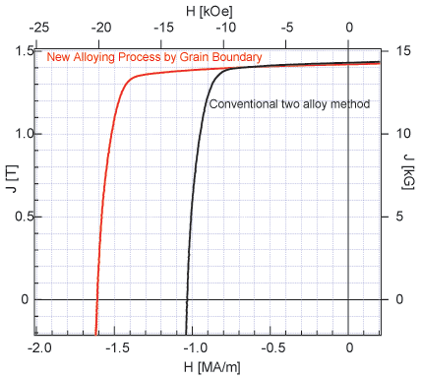
With the New Alloying Process by Grain Boundary Diffusion, Shin-Etsu Chemical makes it possible to realize the magnets with higher performance than our conventional productions.